
Due Sep 17 – Sep 22
The New Left
The Vietnam War helped to bring the practices of protest and resistance from the South to university campuses across the nation. But the antiwar movement had its roots in the idealism that motivated the Civil Rights movement and parallel efforts to “liberate” other historically subjugated populations.
Of Interest: The Military-Industrial Complex
A few years back I got very interested in how the meaning of this phrase changed over the course of the 1960s. I’ll present briefly on this in class; if you’re interested in learning more, here are breadcrumbs for you to follow.
- Watch or read Eisenhower’s “Farewell Address,” available both as a video clip and a transcript. In our second class session, I suggested that at the dawn of the decade, Republicans and Democrats were united in their embrace of a “Liberal Consensus.” That consensus is frequently voiced in this speech. What passage stands out for you as embodying the postwar consensus?
- This speech is, of course, best known for popularizing the notion of a “military-industrial complex.” Reading section IV closely, briefly (2-3 sentences) summarize the threat as Eisenhower perceived it: who was involved, when might it become an issue, and exactly what might result if it went unaddressed?
- As a first instance of how the notion of the military-industrial complex changed over the course of the decade, download the full text of the Port Huron Statement and read the section that focuses on the m-i complex, pp 17-19. In 2-3 sentences, how does this account give new significance to Eisenhower’s idea?
- Finally, examine this sample of articles from the Proquest news database. As you can see from the graphic at right, news references to the “military-industrial complex” declined throughout the decade before rising sharply in 1967-69. Based on all this evidence, what happened 1967 to change this trend? Comparing these instances to Eisenhower’s and and the Port Huron Statement’s usage of the phrase, what story might you tell about how the notion of a military-industrial complex changed over the rest of the decade, as the nation became embroiled in the Vietnam War?
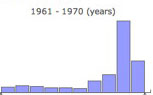
News Refs: M-I Complex
- Show/Hide Thursday’s HW
- Show/Hide Tuesday’s HW
Thursday’s HW
⤹Click the reply button just below.
A commonality between some groups of people between movements involves independent choice. More specifically, how individuals can make a choice about their identity that reinforces what role they play for the movement. Van Gosse highlights “like Black Power, feminism succeeded because it was more of a cultural revolution… anywhere, on any day, an American woman could decide she was a feminist” (Gosse, 32). As Gosse noted, both Black Power and feminism played a role in having that self-identity, but I also noticed that in the Gay Rights Movements, where it was encouraged for one to come out as gay and play a role in maintaining equal rights.
One commonality I noticed was the gradual radicalization of the different New Left movements throughout the 1960s. Gosse describes the period as one in which movements like the antiwar movement and student movement became increasingly willing to challenge existing political institutions rather than simply pressure them for reform. For example, with student movements, peaceful stands such as student organizations or handing out fliers, earlier in the decade, shifted to entire takeovers of institutions, as in Columbia. The phrase “fragmentation and radicalization” captures this shift, especially within SDS, as activists became more confrontational toward the existing system. This process of radicalization happened across a broader “movement of movements,” including antiwar, student, and gay liberation activism, and this was eminent throughout the entire decade as the radical nature of movements grew continuously.
There is one thing that Gosse refers to, and that is mutual hate for being instructed on a hierarchical basis. SNCC went down into the South, and where the communities were able to act as leaders. In the Port Huron Statement, SDS called it “participatory democracy.” Both groups rejected the Old Left concept where party leadership was completely right and in control of the power.
One of the more striking commonalities that I noticed between the radical groups highlighted by Gosse was the uniquely egalitarian and all-inclusive view of American democracy that all of these groups shared. The Preamble to the Constitution states that its goal is to form a “more perfect Union…promote the general Welfare, and secure the Blessings of Liberty” for the nation. These groups followed that piece of writing to its natural and logical conclusion. In a way, these groups, whether they be focused on Black Power, gay liberation, radical feminism, or anti-imperialism, all shared a common goal – an expansion of what democracy, “rule by the people,” meant for everyday citizens, in opposition to the often white, and usually male, political elite. Gosse highlights near the beginning of the introduction the seven main goals of all of the movements, including “the right to walk down the street unmolested,” “the right to love whom you want,” and, most importantly, “the right to be left alone” (Gosse 2). This common goal also allowed the groups to share in each others’ successes – “once,” for example, “the civil rights movement broke through the walls of legal discrimination and disenfranchisement, other marginalized constituencies streamed into that opening,” as Gosse states (Gosse 37). Title IX, for example, followed on the coattails of earlier civil rights legislation. A shared commitment to freedom from harassment, molestation, and discrimination, advocated for through the agreeable lens of democratization, lent every movement that utilized those ideals success, all by unifying in solidarity behind a common ideal.
One commonality that Gosse points out is between the Women’s Rights movements and the Black Power Movement. Both movements fought and demanded massive change, demonstrating willpower while doing so. Gosse compares them saying “like Black Power, Feminism succeeded because it was as much a cultural revolution, a new way of understanding the world, as an organized movement”(Gosse, 32). Throughout Gosse’s introduction it is clear that both movements relied on unity (though sometimes very divided), social unrest, and creating formal organizations. Black Power and Feminism shocked the US and its government by sending a message that there would be no let up until they were heard and there was change.
Two specific groups that Gosse describes a commonality between is the Black Panther Party (BPP) and the American Indian Movement (AIM). AIM modeled their organization after the BPP, instead of working on legal strategies and community organizing they prioritized confronting their abusive white oppressors and retaliating with physical force instead of non-violent protest. Though some people frowned upon this way of demonstrating dissatisfaction, both the BPP and AIM gained serious media attention which helped bring even more attention to both their movement and the police brutality they were met with.
One commonality that I noticed that Gosse highlights is the joint goal of increasing voter registration in the black community between SNCC, CORE, SCLC, and the NAACP. This joint goal allowed them to work together despite their differences to register black voters in Mississippi and using white Northerners to focus a national spotlight on the nation’s most racist state.
One commonality that Gosse highlights is the belief that ordinary people, especially young people, could organize themselves to create social change. Groups such as SDS and SNCC shared the idea that people should not depend on politicians or established institutions to solve problems. Instead, they encouraged young people to become directly involved through things like protests and activism. This common belief connected different New Left groups even though they focused on different issues.
One commonality that was prevalent in my reading of the New Left movements was a challenge to traditional authority and a demand for greater participation in decisions that affected people’s lives. For example, the Student Nonviolent Coordinating Committee (SNCC) challenged established political and racial hierarchies, while the women’s liberation movement challenged traditional gender norms and the authority of male dominated institutions.
One commonality that Gosse mentions between the different movements is the unity that comes from these communities as they fight for change. One of the movements that stood out to me was the Women’s Strike for Peace since these women were self-declared housewives that at the time did not have much power in their communities, but they were eventually able to create a nationwide strike. I believe this has a similarity to Malcom X’s Afro-American Unity organization since he realized that as the movement grew he would need to work with others for the Black community to achieve what they had been working towards for so long.
One commonality the Gosse points out is the tendency of new movements of civil rights to obscure the progress of the old ones, particularly in feminism and gay rights. On page 32 Gosse states “as with the women’s liberation, the new excitement obscured existing gay activism that had been steadily expanding since 1965”. Events that caused a sudden massive uptake in movement for homosexual freedom, like the Stonewall riots, made the previous movements for gay rights dim into the background of such a bright and sudden change. The feminist movement had similar moments, in which sudden extremely radical push, like that for sexual liberation, overshone previous feminist movements which came before it.
Tuesday’s HW
⤹Click the reply button just below.
In “Our Bodies, Ourselves”, the Boston Women’s Health Book Collective writes, “We found we could discuss, question, and argue with each other in a new spirit of cooperation rather than competition” (Gosse, 173). This shows their belief that knowledge should be shared equally rather than controlled by doctors or other authorities. Their ethic is based on cooperation, equality, and empowering women to take control over knowledge about their own bodies. This confirms Gosse’s argument that the New Left was united by a rejection of traditional authority and an emphasis on participation, and it expands the notion by showing how those ideas could be applied to everyday life and personal experiences, not just formal political protest. It builds on the idea of passive resistance that was prevalent in this decade, and overall echoes the idea that independence from the previous administrations was what many movements sought at this time, whether through personal autonomy/quiet protest like the Boston Women’s Health Collective, or through protesting on the streets.
The article I chose was entitled “Declaration of Independence from the War in Vietnam” by Dr. Martin Luther King Jr. Being a leader of non-violent protest, his opinions about the war in Vietnam remain influential, as in a way the war reflected the injustice at home. A quote that stood out to me was “If America’s soul becomes totally poisoned, part of the autopsy out read ‘Vietnam’. (Gosse, 116) This quote is especially relevant because it really shows the impact that this war had on the nation as a whole, and how America can’t really thrive with the burden of this major war it is dealing with. Further along in the passage, he makes clear that “we have no honorable intentions in Vietnam” (Gosse, 116). This statement implies the pointless nature of the war, and there is truly to reason to fight in such a war. As a result of King’s career as a preacher, his call for peace has a profound meaning, as he knows that if negotiations don’t end soon than the country will experience profound loss. At the end of his passage, King explains the revolutionary attitude that is being encountered all through the world, and how that attitude must be channeled in order to challenge poverty, racism, and injustice altogether. This statement is influential as it shifts the narrative about the horrors of Vietnam and applies them to the revolutionary attitude at home, and in a way that this war should spark the non-violent revolution at home in order to continue fighting for rights. Unfortunately, King would die a year following this statement, and would never get to envision the world he played a role in setting.
This statement connects to Gosse’s “New Left” Ideology, confirming it, as it is not just campus protests anymore, but there is a foreign war that the U.S. is getting increasingly involved in. This foreign war should be channeled into making change in the U.S., King writes, which in a way is Gosse’s definition of “the New Left”.
One of the most pivotal passages in Martha Shelley’s 1969 essay “Gay Is Good” fundamentally reframes the debate over homosexuality with a moral inversion. Rather than defending gay people against accusations of deviancy, Shelley makes a striking indictment against straight people, stating that they “have managed to drive [their] own homosexuality down under the skin of [their] mind—and to drive us down and out into the gutter of self-contempt [emphasis added]” (Gosse 140). “Sometimes,” Shelley adds, “we wish we were like you…[and] wonder how you can stand yourselves” (Gosse 141). Rather than treating homosexuality as a sickness, Shelley argues, heteronormativity is instead an abnormality; a sickness in itself that spreads to gay people and demeans them, driving them “down and out into the gutter” (Gosse 140).
Shelley, by going on the offensive and indicting heteronormative society for its treatment of gay people, argues that true morality lies in self-determination and self-actualization, rather than adherence to a larger sense of moral conformity. This falls neatly into one of the central themes agreed upon by the various New Left movements of the Sixties, as Gosse outlines – the right to personal autonomy, or, put more simply, “to be left alone” (Gosse 2). However, Shelley also complicates Gosse’s framework of tolerance and acceptance, as she explicitly rejects the “uncomprehending eyes” and “fake liberal smiles” of contemporary moderates (Gosse 141). True liberation, Shelley argues, requires an active dismantling of how society differentiates its members and treats conformity to the system.
The chapter I read was ‘Wake Up America’ by John Lewis. In his Wake Up America speech Lewis denounces white supremacy and advocates for equality even beyond the Civil Rights Act. He states, “in good conscience, we cannot support the administration’s civil rights bill, for it is too little, and too late. There’s not one thing in the bill that will protect our people from police brutality. This bill will not protect young children and old women from police dogs and fire hoses, [when] engaging in peaceful demonstrations”(Gosse, 76). Although the Civil Right Act was a step in the right direction, Lewis makes it evident that it falls short in some aspects, particularly the protection of Black Americans against brutality and economic inequality, along with the failure of voting rights. In this quote he highlights the immorality that is associated with the racism that Black Americans are experiencing. Similar to the thesis, this passage illustrates that the fight for equality was a combination of pushing for legal changes as well as a fight for social changes. Radicals wanted to fight for both respect and rights, and regardless of the help they received from the federal government, they refused to let up.
The chapter I read was “Student nonviolent coordinating committee statement of purpose.” A passage that shows moral reasoning is “Through nonviolence, courage displaces fear; love transforms hate.” This passage shows that SNCC believed nonviolence was a moral way of living and responding to injustice. The writers argue that people should not respond to hatred with more hatred. Instead, they should use faith to create change. The phrase “love transforms hate” suggests that the goal of the movement was to change society and relationships between people. This shows that SNCC believed social change should be based on strong moral principles rather than violence or revenge.
This analysis mostly confirms Gosse’s thesis about the common themes of the New Left. SNCC’s statement focuses on challenging an unjust social system while also emphasizing equality. The idea of creating a “redemptive community” also shows that the movement wanted to build a different kind of society, not just protest the existing one. SNCC’s goals were strongly connected to religious faith and personal morality. For SNCC, changing society also meant changing the way people treated one another.
I read “Message to the Grassroots,” a speech made by Malcom X during the Northern Negro Grassroots Leadership Confrence in support of Black Power. Malcom says, “I hate to say this about us, but it’s true. How are you going to be nonviolent in Mississippi, as violent as you were in Korea? How can you justify being nonviolent in Mississippi and Alabama, when your churches are being bombed, and your little girls are being murdered, and at the same time you are going to get violent with Hitler, and [World War War II Japanese leader Hideki] Tojo, and somebody else you don’t even know (Gosse 80).” Malcom X uses the anger and sadness of the community from past events such as the 16th Street Baptist Church bombing, to push them towards using violence as a means of revolution. Additionally, he points out how violence has been used in every other part of others’ lives as they have been part of war that has not necessarily included them for so long. I believe that this confirms Gosse’s thesis as to the common themes uniting the New Left since one of the main points that Malcom X focuses on during his speech is Black Power. Since black power was one of the “radical movements” of the 1960s, it shows how the common themes played a huge part in the way leaders of the communities would approach different causes.
“‘I don’t know what’s wrong with women today,’ a suburban psychiatrist said uneasily. ‘I only know something is wrong because most of my patients happen to be women. And their problem isn’t sexual.’ Most women with this problem did not go to see a psychoanalyst, however. ‘There’s nothing wrong really,’ they kept telling themselves. ‘There isn’t any problem’” (Gosse 72).
Friedan engages in moral reasoning regarding the loneliness that women felt during the 1960s. She specifically focuses on the unfairness of the situation women were placed in, in which they were constantly being told that their true and pure calling is that of a housewife. They were made to believe that any other vision or desires for their life and profession were “unfeminine” and something to be ashamed of. Although she doesn’t directly state it, Friedan approaches the issue with a sarcastic, angry tone which indirectly criticizes the pressure and force with which society pushed women into marriage and motherhood, even during high school. I think that Friedan’s work complicates Gosse’s thesis- she emphasizes how women have felt so alone, as if they are the only ones that feel the way they do and that every other woman in the world is perfectly content. She says that the problem “lay buried” (Gosse 68); women were ashamed that they weren’t satisfied with their lives as they were, so they buried the feelings and never shared them, so they never knew that anyone else felt the same way. This emphasizes the loneliness of the feelings that sparked the feminist movements, showing that the “New Left” was definitely not inclusive of feminism, since they felt so alone in their fight for justice.
In El Plan de Santa Barbara, MEChA’s moral reasoning is especially clear when the writers argue that “the ethic of profit and competition, of greed and intolerance” should be replaced by “our ancestral communalism and love for beauty and justice.” This passage shows that the authors are not simply arguing for political or educational change; they are making a judgment about what kind of life and society is morally good for latinos in the U.S. They associate the dominant Anglo-American society with profit, competition, greed, and intolerance, values that they see as producing individualism by “selling out” and separating people from their communities. In contrast, they present “communalism,” “beauty,” and “justice” as positive values that should guide Chicano life. The word “should” is important because the writers are establishing an obligation: Chicano students have a responsibility to use their education and their position in society for the liberation of their community rather than simply for personal advancement. This becomes even clearer when the document says that liberation from “prejudice and oppression” is a responsibility greater than “personal achievement” or degrees earned at the expense of cultural identity. The fundamental ethic of El Plan is therefore that individual success has value only when it remains connected to the well-being, dignity, and liberation of the community. This both confirms and complicates Gosse’s thesis about the common themes of the New Left. It confirms his emphasis on liberation, opposition to oppressive social structures, and the rejection of traditional individualistic values in favor of community and collective action. At the same time, El Plan shows that these ideas were not expressed identically across the New Left: MEChA grounds its moral vision specifically in Chicano history, cultural identity, and “ancestral communalism.” In this sense, the chapter demonstrates how a broader New Left ethic of liberation could be adapted to the particular historical experiences and cultural identity of a specific movement.
In the third World Women’s Alliance’s “Equal to What?” they make the argument that there needs to be a feminist movement for women of color because the white woman’s feminist movement is striving to be just as powerful at oppressing people of color and other oppressed groups as the wealth white man. They write that “There are serious questions that white women must address themselves to. They call for equality. We answer, equal to what? Equal to white men in their power and ability to oppress Third World people??” They engage in moral reasoning in order to specify why their group should be separate. They reason that if the white woman is striving to be equal to the white man, something they cannot achieve due to the racism that is so prevalent in the United States, then their movement should be separate because their needs are separate. I think that this supports Gosse’s thesis because even women of color in this case are making a clear divergence from the goals of the more moderate white women, they express many themes which are similar to the other movements of their time. For example, at the end of the passage they call for revolution not reform, something which is reminiscent of the Black Panthers, and other more radical groups. Additionally, throughout the passage they talked about the injustice of the war in Vietnam, issues in Latin America, and the injustice of other women of color, not just black women, which ties into a theme of coalition building which was prevalent with other groups throughout the decade, such as during Freedom Summer.
Friday’s HW
⤹Click the reply button just below.
Extra: How the M-I Complex Changed
⤹Click the reply button just below.
“There is deep uncertainty among Americans as we face the world. It is not a matter of our suddenly feeling unsure of ourselves in a world where the Soviets have boldly proclaimed their superiority in science. Nor a matter of the same power that can launch an artificial satellite into space being able to hurl a hydrogen bomb in eighteen minutes across the ocean.” (SANE, Novemeber 15, 1957) and “…the same propulsion device that can send a man-made satellite into outer space can send a missile carrying a hydrogen bomb across the ocean in eighteen minutes.”(Van, Gosse)
In ignoring the Soviet Union’s “scientific supremacy” and lookingat the danger posed by an 18 minute “hydrogen bomb” attack as the real source of national fear, the authors demonstrates an perspective that places humanity above petty country rivalry. The authors don’t define the arms race as just a standard conflict betweeen nations but rather talk about it as a completely new ethical challenge. This proves Van Gosse’s hypothesis: the activism of SANE is a clear example of how the New Left ethics refuses to accept the Cold War ideology and avoid country disputes that is associated with such incidents as the launching of Sputnik.