Due Sep 20 – Sep 22
The New Left
The Vietnam War helped to bring the practices of protest and resistance from the South to university campuses across the nation. But the antiwar movement had its roots in the idealism that motivated the Civil Rights movement and parallel efforts to “liberate” other historically subjugated populations.
Of Interest: The Military-Industrial Complex
A few years back I got very interested in how the meaning of this phrase changed over the course of the 1960s. I’ll present briefly on this in class; if you’re interested in learning more, here are breadcrumbs for you to follow.
- Watch or read Eisenhower’s “Farewell Address,” available both as a video clip and a transcript. In our second class session, I suggested that at the dawn of the decade, Republicans and Democrats were united in their embrace of a “Liberal Consensus.” That consensus is frequently voiced in this speech. What passage stands out for you as embodying the postwar consensus?
- This speech is, of course, best known for popularizing the notion of a “military-industrial complex.” Reading section IV closely, briefly (2-3 sentences) summarize the threat as Eisenhower perceived it: who was involved, when might it become an issue, and exactly what might result if it went unaddressed?
- As a first instance of how the notion of the military-industrial complex changed over the course of the decade, download the full text of the Port Huron Statement and read the section that focuses on the m-i complex, pp 17-19. In 2-3 sentences, how does this account give new significance to Eisenhower’s idea?
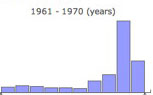
- Finally, examine this sample of articles from the Proquest news database. As you can see from the graphic at right, news references to the “military-industrial complex” declined throughout the decade before rising sharply in 1967-69. Based on all this evidence, what happened 1967 to change this trend? Comparing these instances to Eisenhower’s and and the Port Huron Statement’s usage of the phrase, what story might you tell about how the notion of a military-industrial complex changed over the rest of the decade, as the nation became embroiled in the Vietnam War?
News Refs: M-I Complex
- Show/Hide Tuesday’s HW
- Show/Hide Thursday’s HW
Tuesday’s HW
⤹Click the reply button just below.
One commonality of the New Left was that each movement had their own version of “speaking truth to power” and “putting one’s body on the line” to accomplish this. Each group made sacrifices for their movement. For example, the Civil Rights movement broke segregation laws by participating in sit-ins, which would put each individual at risk for arrest and police violence. Similarly, anti-war groups would lay down in front of trucks or trains that were carrying weapons to be used in the war or people being sent to war in Vietnam. This put them at personal risk just like those participating in sit-ins.
One commonality between the major radical groups of this era is their determination to their causes, having the resilience to support their ideals no matter the cost. The shared belief in equality for all people regardless of race, gender, sexuality, etc. allowed for the progressive youth to engage in nonviolent protests and organizations (typically instances of “civil disobedience”), such as the Freedom Summer Project, in which northern white college students urged African Americans in Mississippi to register to vote as means of elucidating the blatant racism of the state. The mantra of putting “one’s body on the line” was a key shared philosophy among these radical groups.
The Southern Christian Leadership Conference (SCLC) and the Free Speech Movement (FSM) are groups that resemble each other. These two organizations utilize the brutal response of the police officers and the powerful presence of the media to expand their struggle across the nation. Through this, they gain national attention, along with many civilians that agree with their standpoint. Ultimately, this pressures the state and federal government to make the desired changes for these groups before things get more chaotic.
A commonality between different new Left groups was a shift from generally liberal beliefs to more radical ideals. This can be seen in the Civil Right’s movement, with the emergence of SNCC and CORE which took a far more radial stance than previous organizations, such as the NAACP. This change can be seen with their shift from being interracial organizations to exclusively black.
This adjustment reminded me of the women’s rights movement as well. The formation of “radical feminist” groups, such as the Westside Group demonstrate a similar shift as the Civil Right’s movement. In both instances, activists altered their purpose from appealing to liberal audiences to focusing on pushing radical changes.
One commonality that Grosse highlights is the use of student voice and protest across radical groups. He mentions the junior high students that risked themselves for the SCLC in protest of racial discrimination, as well as groups like SDS, HUAC, and the FSM who were all fighting for more political power. All three groups were heavily led by student voice, often times fostered on campuses, and emphasized the importance of having an impactful voice in both legal and social settings.
A common thread between many radical groups of the Sixties was their focus on the individual and their legal rights as an American (and more generally, as a human being). After World War 2, the origins of the New Left started to take shape as people began to criticize the constraints on Americans current liberties: “Were all people ‘created equal’ with ‘inalienable rights,’ as the Declaration of Independence promised?” (2) Throughout the Sixties, questions as such only became more prominent as a multitude of radical groups rallied around fighting these injustices. Many of these groups – such as the NAACP and the Mattachine Society – attempted to fight for equality similarly through the use of “more aggressive strategy of legal action and protest”, a method of identifying their rights as an American and how they weren’t being met as a call for change.
One connection between two of the movements Gosse discussed in the introduction was the religious ties and roots in both the Civil Rights Movement and the antiwar movement. In the Civil Rights Movement, much of the organization and mobilization came from the churches, as well as prominent leaders such as MLK, and spiritual and religious messages of morality and hope and unity drove much of the protests. Gosse noted that a significant part of the antiwar movement was Catholics, who played a huge role in igniting and continuing the protests.
Van Gosse’s account of the New Left is accompanied by his comparing and contrasting of radical groups throughout the 1960s. Most notably, the Student Nonviolent Coordinating Committee (SNCC) was a leading organization during the New Left era, seeking potential changemakers within the young black community and subsequently transforming them into tomorrow’s leaders. Furthermore, Gosse draws a parallel between the SNCC and the Congress of Racial Equality (CORE), a different organization responsible for the infamous Freedom Rides. The commonality between these two groups is established through their similar intentions, which included the “jail no bail strategy” to garner public attention (Gosse 9). Gosse effectively analyzes the precursory ambitions of SNCC and CORE, alluding to their respective and united role in the Civil Right Movement’s campaigns.
A commonality among the many radical groups were how many groups contradicted the norm and may have sided with views they would not have initially supported. In the continuous call for action, two groups that I noticed that acted unexpectedly were the Vietnam Veterans Against War and the Free Speech Movement. The duality solely within the name of the VVAW, along with the contradictory behavior of the many beliefs that came together to form the FSM, highlight the imminent need for change and significance of the change each respective group fought for.
One commonality amongst the New Left organizations is the overarching goal for reform. Unlike other political groups that focus on restricting certain human rights, these New Left organizations primarily focus on correcting inequities and discrimination in today’s government and society. This also leads to their approach commonly being nonviolent tactics in attempt to not create even more conflict but resolve it. For example, the text mentions a group that removed a radical leader from the organization which can be controversial it is also important to note that it was in an attempt to avoid conflict and increase the likeliness of reaching their initial goal.
Thursday’s HW
⤹Click the reply button just below.
On October 29, 1966, the National Organization for Women (NOW) gave their “Statement of Purpose”, in which the speakers essentially embodied the Civil Rights Era attitude of saying the prohibition of oppression was long overdue. This speech disputes the archaic cult of domesticity that has stifled the liberation and equality of women, noting technological and societal progressions that make gender equality more welcome during the civil rights era. Highlighting equality is a crucial element to the structure and persuasion of the speech, especially when they describe women as “human beings, who, like all other people in our society, must have the chance to develop their fullest human potential” (Gosse 108). By focusing on the humanity of the women’s rights cause, the speakers from NOW are openly bold and unapologetic about their fight against oppression, not letting stigmas or preconceived notions prevent the successful delivery of their message. As a result, it is evident that they confirm the common themes that Gosse claims united the New Left, especially the notion that they were willing to put themselves and everything on the line to make progress.
Document: Third World Women’s Alliance: Equal to What? (1969)
The Third World Women write in their document “Equal to What?” that “some women in the movement cannot understand why we exclude whites from our meetings and program. The argument that we are all equally oppressed as women and should unite as one big family to confront the system is as artificial as the argument that Third World women should be fighting on only one front” (133). On the surface, this section affirms Gosse’s theory that New Left groups do indeed attempt to extend democracy and equality to all people, specifically women of color in this case. The mention of fighting multiple fronts suggests that these women are working with other groups, like the New Left movements that focus on the advancement of people of color. However, the specific exclusion of white women in this document suggests that the Third World women acknowledge that they are fighting a unique battle. This complicates Gosse’s theory, as this document goes on to suggest that these white women are not only fighting a different battle than other New Left movements, but that the white feminism movement is inherently perpetuating the obstacles that the Third World women are attempting to destroy. The Third World women write to the white women, “…until you can deal with your own racism…you will never be a liberation movement.” Gosse’s theory references the unification under the intent to advance everyone in society together. The complications here stem from the fact that the white feminism movement directly harmed the Third World Women’s movement. The advancement of white women into equality with white men only meant that there were more white people attempting to suppress any minority, including the Third World Women. The Third World Women are confronted with the conflict between ensuring the advancement of their own community versus putting their movement and values at risk simply to placate a group of white women, and they deem their movement more important.
Document: John Lewis, Wake Up America! (1963)
For this document, John Lewis highlights many struggles that African Americans go through, even though they are approaching civil rights. For his speech, Wake Up America!, he gets straight to the point, saying that as they march that day, “we have nothing to be proud of” (Gosse, 76). These feelings of displeasure are justified, for African Americans were suffering in the same predicament as they have been in the last century. Unfair wages, police brutality, and unequal citizen rights are just a few on a laundry list of trials these African Americans faced at the time. However, the biggest problem in this text is the idle Federal Government that has done little to nothing to assist African Americans, and Lewis makes sure to highlight this problem. He states that We will not wait for the courts to act, for we have been waiting for hundreds of years. We will not wait for the President, the Justice Department, nor Congress, but we will take matters into our own hands and create a source of power, outside any national structure that could and would assure us a victory” (Gosse, 77). This passage confirms Gosse’s theme of commonalities within groups of the New Left. An important fact to consider is that this event was during the March on Washington in August 1963, where over 250,000 protesters came in attendance. Among those protesters were many Civil Rights organizations such as NAACP, SNCC, and SCLC. Among these groups comes a single motive: impatience. These protesters and leaders are growing impatient with fighting for something they should’ve had at birth. In general, African Americans have grown impatient with a government taking baby steps to make the necessary changes to glaring problems in the society they govern. Now, they are willing to defect from the government’s aid to find something that will work for them. Gosse has highlighted the impatience of Civil Rights in many ways, from showing the number of movements for Civil Rights to the brutal attacks that African Americans endure from white supremacy. Overall, these factors take a physical and mental on African Americans, which led them to come together to all pressure the Federal Government to step up and take action for their rights.
Document: Gay is Good (1969)
This document, written by Martha Shelley, encases a unique point in the Gay Liberation Movement. In an attempt to be understood, Shelley notes that, “The worst part of being a homosexual is having to keep it secret. Not the occasional murders by police” (139). This speech is different than others because she did not preach for acceptance or even tolerance as she describes that people never truly accept them while claiming that they do. Instead, she requested an understanding and level of equality. People have been forced to repress their identity to allow for comfort for others that prefer the social norm. People are forced to hate themselves and feel a constant level of discomfort within to avoid an outward rejection from society that they already feel internally. This leads into her idea that complicates Gosse’s thesis because she claims that liberalism isn’t good enough because, “Your friendly smile of acceptance— from your safe position of heterosexuality— isn’t enough…[with] that secret belief that you are little bit better because you sleep with the opposite sex” (139). This statement highlights the problematic nature of performative activism as she claims that liberals get a token for supporting homosexuality when in reality, they really just place labels on these individuals and meet them with pity as opposed to equality.
In 1951, the Mattachine Society released their “Statement of Purpose”, outlining the core beliefs the society held and its plans for the future. The organization was somewhat unique in its focus on education and creating a community of support for gay individuals. They state that “thousands of homosexuals live out their lives bewildered, unhappy, alone–isolated from their own kind and unable to adjust to the dominant culture” (40), making community building of utmost importance. The Mattachine Society is somewhat reminiscent of other earlier New Left groups, such as the NAACP, which were much more conservative in relation to organizations that emerged later. Also similar to the NAACP, one of their main goals was to push for political change, removing discriminatory legislation that targeted homosexuals. The Mattachine Society stands out, however, from many New Left groups as it was not much of an activist organization. While many New Left groups used large and often confrontational protests to push for radical changes, the Mattachine Society was not home for this kind of activism. Lastly, the release of their founder, Harry Hay, because of communist ties, sets it apart from later organizations as well.
Document: Gay Is Good (1969)
“And the days pass, until we look at you out of our homosexual bodies…bodies that are no longer bodies but labels; and sometimes we wish we were like you, some times we wonder how you can stand yourselves” (140, 141)
Martha Shelley, a lesbian at the forefront of the gay rights movement in New York, employs two main methods or moral argument in her essay Gay is Good: that gay people are misunderstood by the mainstream because they’re only viewed as a gay person – not just a person – and the criticism of the contradictory rhetoric widely used by heterosexuals. In the quote above, Shelley directly expresses that gay people’s personhood is overlooked, the fact that gay people can be valuable members of the community is immediately out of the question. Shelley also calls this into question implicitly – by crafting such an intelligent essay, she is proof that being an accomplished, decent person and being a lesbian aren’t mutually exclusive and shouldn’t be a moral argument. Through the end of this quote, Shelley also identifies the moral paradox that straight people claim being gay is “unnatural,” but then abide by their unnatural gender roles. The method of directly attacking the society her intended audience – straight people – stands for is risky, but her way of logically analyzing and explanation her view of the farces of gender roles and other heterosexual expectations is effective nonetheless.
Through Shelley’s essay, Gosse’s thesis that the New Left was united in several commonalities is both supported and disproved. Though Shelley tells the gay community that “liberalism isn’t good enough for us” (139) and to align with the New Left, as many other movements were also turning more radical, she also verbalizes that the gay community stands divided from other radical groups because they are deeply homophobic: “We’re sick of the Panthers lumping us together with the capitalists in their term of universal concept – ‘f—–.’” (138)
The New York Radical Women: Principles (1968) is like the ideology and mission statement of the group. It is what they stand for and why they fight for their cause. Much like other freedom causes, it states “until Everywoman is free, no women will be free” (Gosse 123). In this sense, it is similar to many of the other New Left groups and confirms Gosse’s thesis in the commonality among them. The completly radical views within this piece highlight one of the extreme points of view that many activists who fought for their freedom felt. This all-in mindset is seen throughout many of the New Left movements, not just the women’s rights movement. The fundamental ethic in this piece highlights the importance that women are given the rights they deserve no matter the cost and that within the society that they lived in (and that we still live in), women can only count on each other and cannot leave their fate in the hands of the men within their “male supremacist culture” (Gosse 124). By underscoring the struggle that women face as a collective and emphasizing that this fight is for all women and not just the women who get directly treated badly by men, they encourage women who have benefited from the patriarchy to join the cause while also revealing how even the benefits of the patriarchy come at a cost.
Document: Malcolm X, Message to the Grassroots, November 10, 1963
“He’s an enemy to all of us. I know some of you all think that some of them aren’t enemies. Time will tell…” (79).
Malcolm X was approaching the pinnacle of his role during the Civil Rights movement with his Message to the Grassroots, as he addressed the grave issues of blacks living in a white world and the true concept of revolution in the city of Detroit. Speaking at the roots of the Black Power movement, X carefully analyzes the “common enemy” within America and perpetually uses the word “common” with intent to further emphasize the passion and intent for his choice of vocabulary (79). This common enemy was the white man, and Malcolm’s interaction of ethics initiates this discussion of the common enemy through his view of morality for whether the whites were truly enemies or not. Furthermore, the repetitive nature in which X conveys the “revolutions,” starting from the initial American Revolution to differentiating “between a black revolution and a Negro revolution,” exudes the need to reclassify history and what truly makes up a revolution (81). Malcolm X’s perspective aligns well with Gosse’s themes of the New Left, as both pushed forward the need to make a palpable change as their leading argument. Just as the SNCC and CORE adopted their strategies to flood the jails, X revolutionized the minds of the public to take part in such movements, ultimately creating the common thread of fighting in unison within the New Left.
Document: Bella Abzug- Testimony Before the New York City Human Rights Commission (1970)
In her testimony before the NYC Human Rights Commission, Bella Abzug says in regards to women making change and demanding political power “And we are not going to wait another fifty years to do so. If some men complain that we are ‘boisterous and aggressive’ instead of ‘delightful and delectable’… that’s all right with us.” (Gosse, 163) Upon examination, this is in line with the commonality Gosse draws between groups of the idea of “putting one’s body on the line”, except in this particular case it is not the women’s bodies, but their reputations, perceptions of them, their personas. Abzug and was well aware that “the whole world was watching”, and that in order to make the change that needed to be made, radical feminists had to make some noise and step out of the dainty and proper and silent roles they had always been forced into. And in doing so, they were putting everything they had been taught aside, everything the people around them believed, about how women should act and behave, and risked backlash from it. Much like other movements Gosse argues were a part of the New Left (Civil Rights, antiwar), these radical feminists were ready to take risks to draw attention and enact swift change.
Document: Black Panther Party for Self-Defense, The Ten Point Program: What We Want/What We Believe (1966)
“10. We want land, bread, housing, education, justice and peace.”
Huey P. Newton and Bobby Seale laid out ten commandments that defined the basic desires of the Black Panther Party. While their entire program is filled with characteristics that could be compared to various groups found in the 60s, the 10th point can compare to a variety of groups as well as Gosse’s themes of using whatever means necessary to achieve the equality that people desire in this “New Left” era. In setting up the 10 Point Program to resemble the Declaration of Independence, Newton and Seale were able to directly call out the United States for not including all races in phrases like “we the people” and “all men are created equal” (Gosse, 106). This point also combines a variety of movements that were happening at the time over hot topics like political strength, education, and general equality. Other themes, including political power, freedom of speech, judicial representation, and the right to education, are seen throughout the program as well. Newton and Seale were able to establish their political knowledge by referencing things like the international conflicts in Germany, the 2nd and 14th Amendments of the U.S. Constitution, as well as direct quotes from the Constitution. Overall, Newton and Seale seem to demonstrate a variety of themes that Gosse highlights as the “New Left”, the main one being the organization’s obvious intentions to do whatever it takes to get the equality they want.
Friday’s HW
⤹Click the reply button just below.
Extra: How the M-I Complex Changed
⤹Click the reply button just below.